Solar System Installation in Sudan Darfur
Darfur
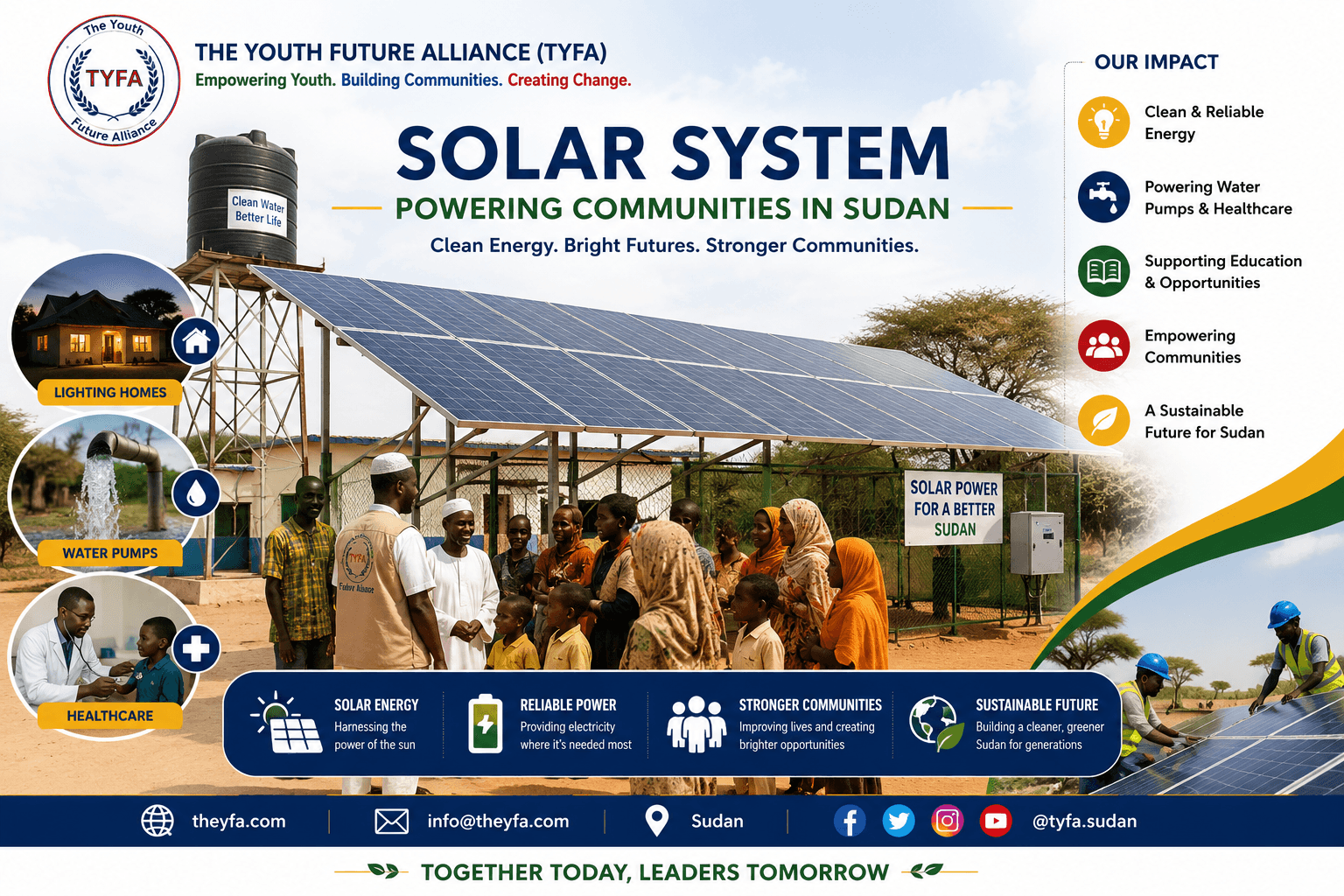
Installing community solar power systems in Darfur to support schools, clinics, and safe evening study spaces.
Collecté
$2,100
Nécessaire
$6,000
Déficit
$3,900
Rapports
This page summarizes project progress, funding requirements, and peace initiatives led by The Youth Future Alliance to support people affected by conflict in Sudan.
Total collecté
$12,151
Total nécessaire
$31,841
Déficit de financement
$19,691
Darfur
Installing community solar power systems in Darfur to support schools, clinics, and safe evening study spaces.
Collecté
$2,100
Nécessaire
$6,000
Déficit
$3,900
Sudan
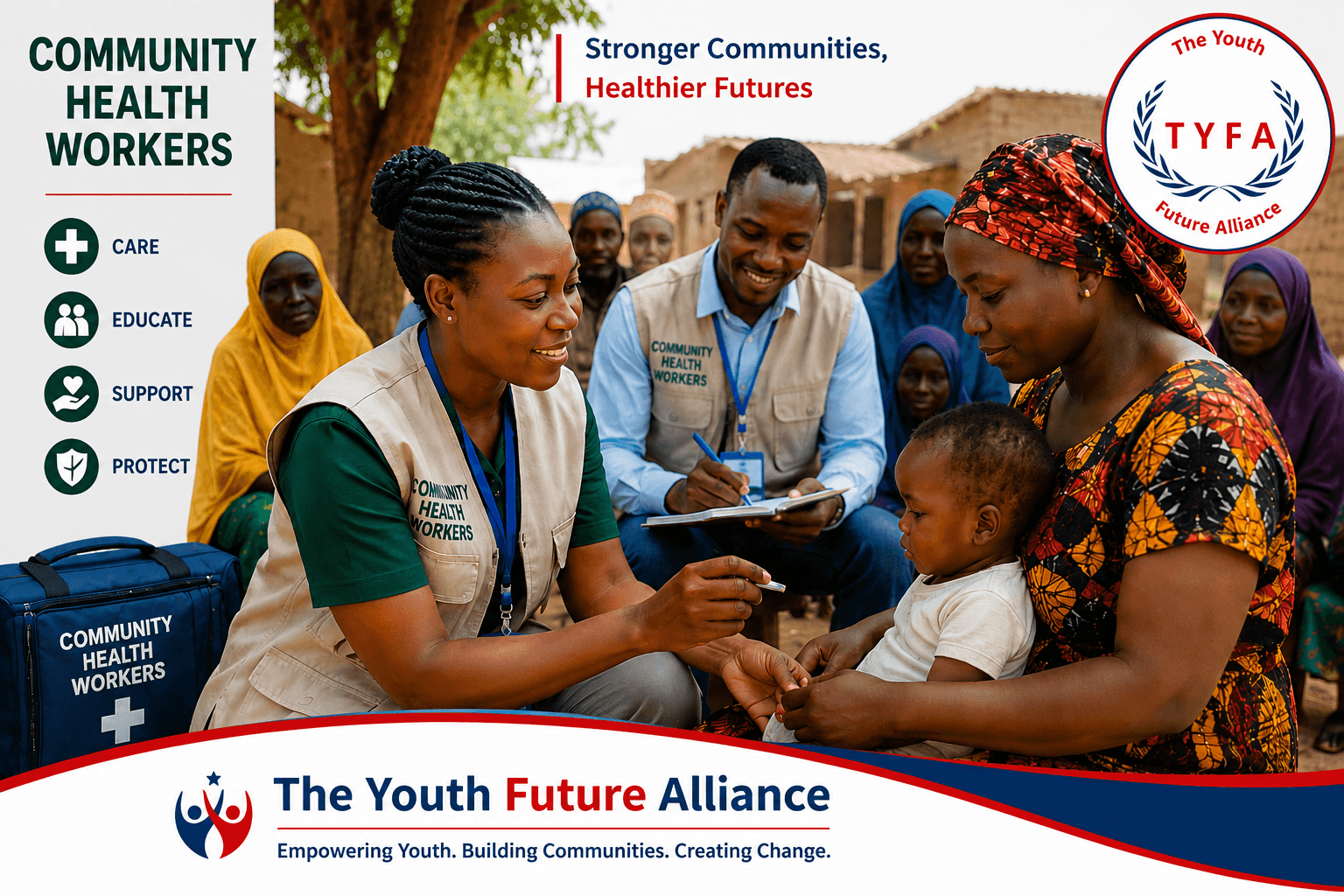
Training local volunteers to provide basic health services and referrals.
Collecté
$4,500
Nécessaire
$6,429
Déficit
$1,929
Sudan
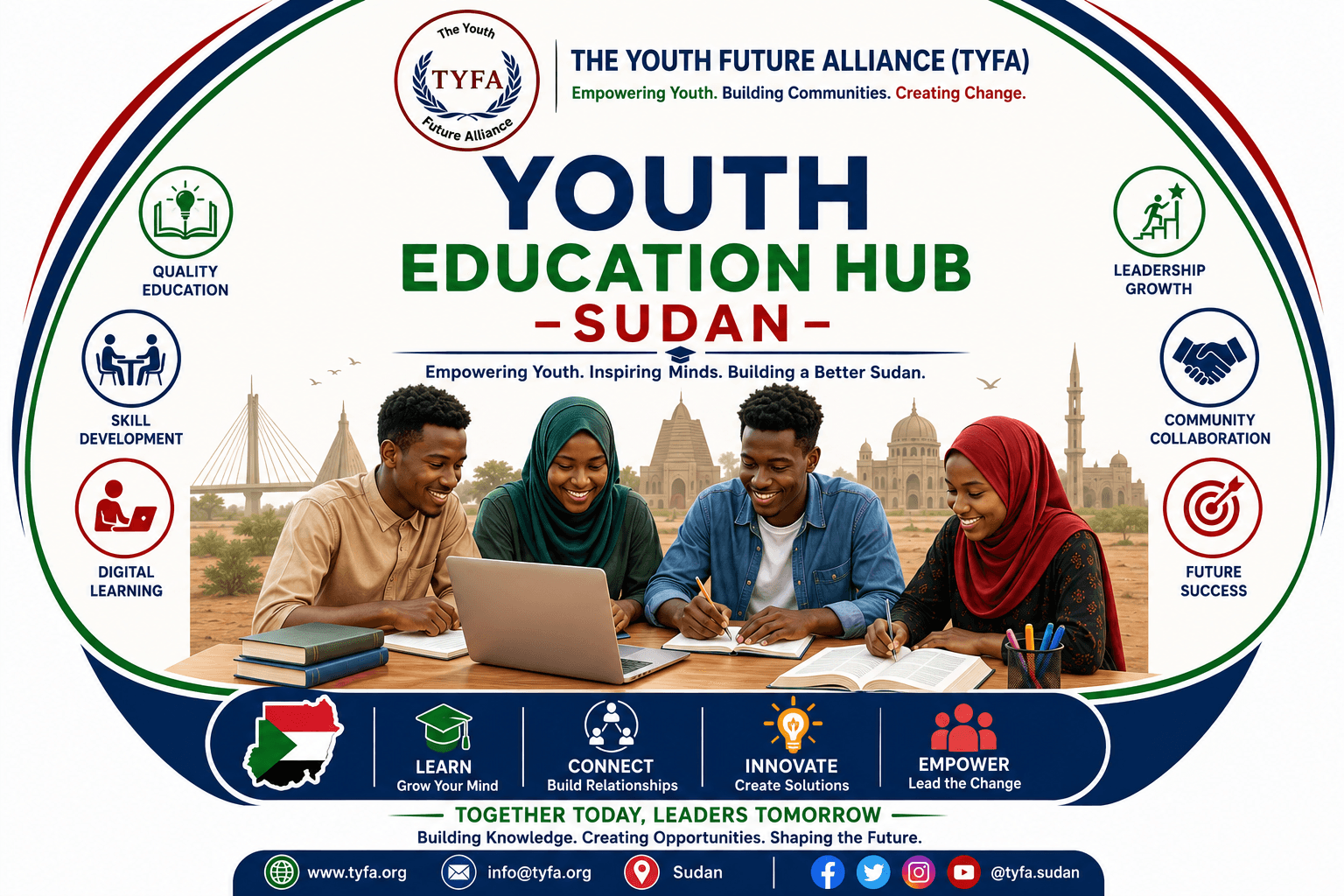
Providing after-school tutoring, mentorship and digital literacy for underserved youth.
Collecté
$1,201
Nécessaire
$2,668
Déficit
$1,468
Kordofan
Solar-backed community access points in Elfoola to improve learning continuity and basic services.
Collecté
$850
Nécessaire
$3,148
Déficit
$2,298
Darfur
Community youth clubs in Jinana supporting literacy, digital basics, and peer mentoring.
Collecté
$500
Nécessaire
$2,632
Déficit
$2,132
Darfur
Skills and livelihood support tracks for youth in Eldaein, linked to local market opportunities.
Collecté
$700
Nécessaire
$2,917
Déficit
$2,217
Darfur
Expanding youth health and education outreach coordination in Nyala through local volunteers.
Collecté
$1,100
Nécessaire
$3,333
Déficit
$2,233
Darfur
City-based youth support in Elfashir focusing on school power reliability and evening learning hubs.
Collecté
$900
Nécessaire
$3,214
Déficit
$2,314
Sudan
Workshops on carpentry, tailoring, and small-business management for youth.
Collecté
$300
Nécessaire
$1,500
Déficit
$1,200
Affichage de 1–9 sur 9 rapports de projets
Ces initiatives misent sur le dialogue local, le leadership des jeunes et une coordination communautaire sûre pour réduire la violence et renforcer la cohésion sociale.
Active in 6 communities
Facilitated dialogue circles brought youth leaders, elders, and women groups together to reduce local tensions and agree on non-violent problem solving channels.
Elfashir, Nyala, Eldaein, Jinana
Lire la suite →Ongoing
Cross-community coordination helped reopen learning spaces with local safety agreements, keeping children in class and reducing conflict pressure around school sites.
Darfur learning zones
Lire la suite →Pilot complete
A youth ambassador network delivered awareness campaigns on coexistence, rumor reduction, and protection pathways, supporting trust-building across neighborhoods.
Nyala and Elfoola
Lire la suite →Going on
Sudan continues to experience a severe food security and nutrition emergency. The latest available Integrated Food Security Phase Classification (IPC) analysis estimates that approximately 19.5 million people—41 per cent of the analysed population—were facing IPC Phase 3 (Crisis) or worse acute food insecurity through May 2026. This included more than 5 million people in IPC Phase 4 (Emergency) and approximately 135,000 people in IPC Phase 5 (Catastrophe). IPCinfo The available evidence indicates that armed conflict, mass displacement, disruption of agricultural production and markets, high food prices, destruction of civilian infrastructure and restrictions on humanitarian access remain major drivers of the crisis. FAO's 24 September 2026 country update identifies 14 areas in North Darfur, South Darfur and South Kordofan as being at risk of famine under a worst-case scenario involving increased violence and displacement. FAO GIEWS The crisis is particularly serious for children. UN agencies estimate that approximately 825,000 children under five are expected to suffer severe acute malnutrition (SAM) during 2026. World Food Programme This report combines information published by UN agencies and the IPC with direct field observations collected by The Youth Future Alliance (TYFA). Field observations are identified separately and should not be interpreted as independently verified UN findings.
Sudan
Lire la suite →Active
Sudan continues to experience a major displacement crisis despite substantial return movements during 2025 and 2026. According to the International Organization for Migration's Displacement Tracking Matrix (IOM DTM), approximately 8.58 million people remained internally displaced across Sudan as of 26 August 2026. IOM also recorded approximately 5.15 million returnees, reflecting substantial movements towards areas of origin. Children account for a significant proportion of both populations. IOM's August assessment indicates that approximately 55% of internally displaced persons and 50% of returnees are under 18 years of age. Return movements represent an important change in Sudan's displacement pattern, but they should not be interpreted automatically as evidence of humanitarian recovery. Earlier IOM assessments found that many returning households were going back to damaged homes and areas where basic services and livelihoods had been severely disrupted. This report consolidates available humanitarian evidence with information collected directly by The Youth Future Alliance (TYFA). External statistics are clearly attributed to their originating organisations, while TYFA field observations and community testimony are separately identified.
Sudan
Lire la suite →Active
Communities across Darfur continue to experience serious disruption to healthcare, water, education, markets, transportation and other essential civilian services as a consequence of prolonged conflict, displacement, infrastructure damage and constraints on humanitarian operations. This report focuses on El Daein, Nyala and El Geneina, drawing on publicly available humanitarian evidence together with testimony collected directly by The Youth Future Alliance (TYFA) from displaced people, residents and returnees, community representatives and humanitarian workers in these three cities. The wider humanitarian context remains severe. UNICEF estimates that 33.7 million people across Sudan require humanitarian assistance, including 17.3 million children. During the first half of 2026, UNICEF and partners nevertheless provided 6.6 million people with access to safe water and supported approximately 1.3 million people with primary healthcare, demonstrating both the scale of humanitarian intervention and the continuing level of need. UNICEF Darfur remains particularly affected. UNICEF reported in April 2026 that violence, hunger and displacement continued to affect children across the region, with homes burned and markets, schools and health facilities damaged or destroyed. UNICEF Evidence reviewed for this report also demonstrates that the situation differs substantially between individual Darfur cities. For this reason, TYFA does not treat Darfur as a single homogeneous humanitarian environment.
Sudan
Lire la suite →Affichage de 1–6 sur 6 initiatives de paix